
funSpec
Research
Fast spectroscopy of quantum emitters
In nanoscience, three attributes of a system are intimately linked:
(1) Nano-scale size
(2) Manifestation of quantum nature of electrons and photons
(3) Fast electronic dynamics
The link between the first two is used to engineer sources of quantum light (2), for example, by chemical synthesis of nanocrystals (1) (quantum dots). Their small size dictates an emission of one photon at a time - a phenomenon termed photon antibunching.
The link to attribute (3), on the other hand, is often viewed as an unwanted byproduct. To understand and use these systems we have to measure as fast as they evolve. This requires the development of spectroscopic tools that are not yet found in the standard spectroscopy toolbox.
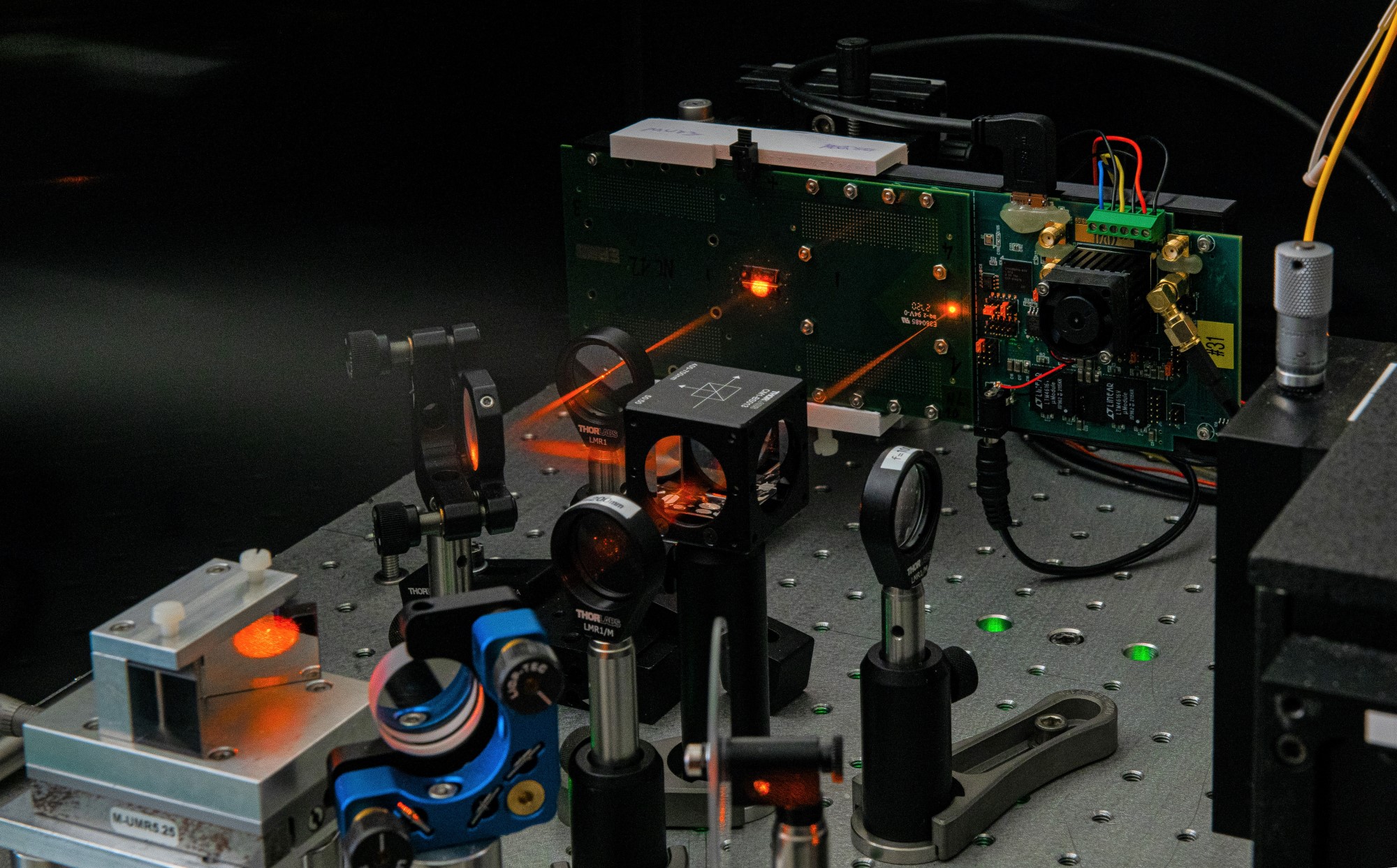
In the funSpec lab, we do exactly that! For example, we take advantage of recent advances in the technology of single photon arrays to extend the temporal resolution of spectrometer by 7 orders of magnitude!
Understanding ultrafast dynamics in nanocrystals
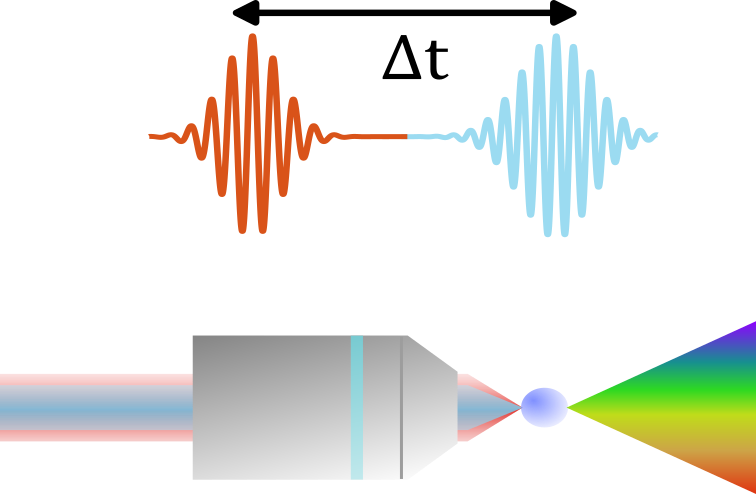
Some electronic dynamics in nano-sized systems can be followed with "fast" spectroscopy down to the nanosecond (10^-9 second) scale. But a full understanding of the system can only be obtained once follow it down to the femtosecond (10^-15 second) regime.
Here, we encounter another important byproduct of nano science - try as we may, the product of synthesis is never entirely homogeneous. For example, nanoparticles resulting from the same synthesis differ in size by ~10%. This means that the ultimate experiment must be performed one nanoparticle at a time.
In the funSpec we face this challenge by performing pump-probe experiments on single quantum dots. This is a huge challenge as these quantum dots, roughly interact with 1 out of 10^6 photons we focus. With stable pulsed lasers and some experimental tricks this was already demonstrated and will be utilized in the future to explore these systems beyond our current understanding.
New quantum states of light: fast control of a quantum emitter
Beyond creating the single photon state, can quantum dots generate new states of lights that we science have not yet achieved? The answer is a certain yes. In fact, the portfolio of quantum state emitted from single nanocrystals already include entangled photon states and even cluster states.
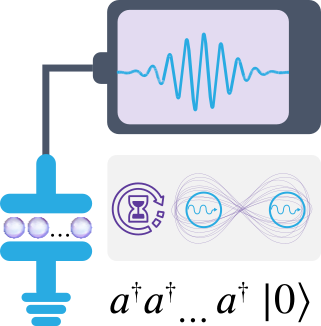
In the funSpec lab, we want to think about the dimension of time as something we can use in our advantage! Using an electric field, we can change the energy of photons emitted by a nanoparticle. But what happens when we change the electric field while a single photon is irradiated from a quantum dot? What kind of single photon state are we creating?
We believe that this is the gate for some fascinating physics and are striving toward performing time domain biasing of nanoparticles in multiple regimes. One of them is by using electromagnetic waves in the terahertz (10^12 hertz) frequency band. Only in recent years has the generation of terahertz pulses from strong laser pulses become simple enough to perform elaborate experiments with. We want to bring this technology to the single quantum dot regime.
Contact Us!
Schulich Faculty of Chemistry,
Technion - Israel Institute of Technology
Haifa, 3200003
Israel